
Complete Export Documentation Guide for Kenyan Businesses: From Farm to Foreign Markets
Step-by-step guide to export documentation requirements for Kenyan businesses. Learn about certificates, permits, and procedures to successfully export to EU, Middle East, and Asian markets.
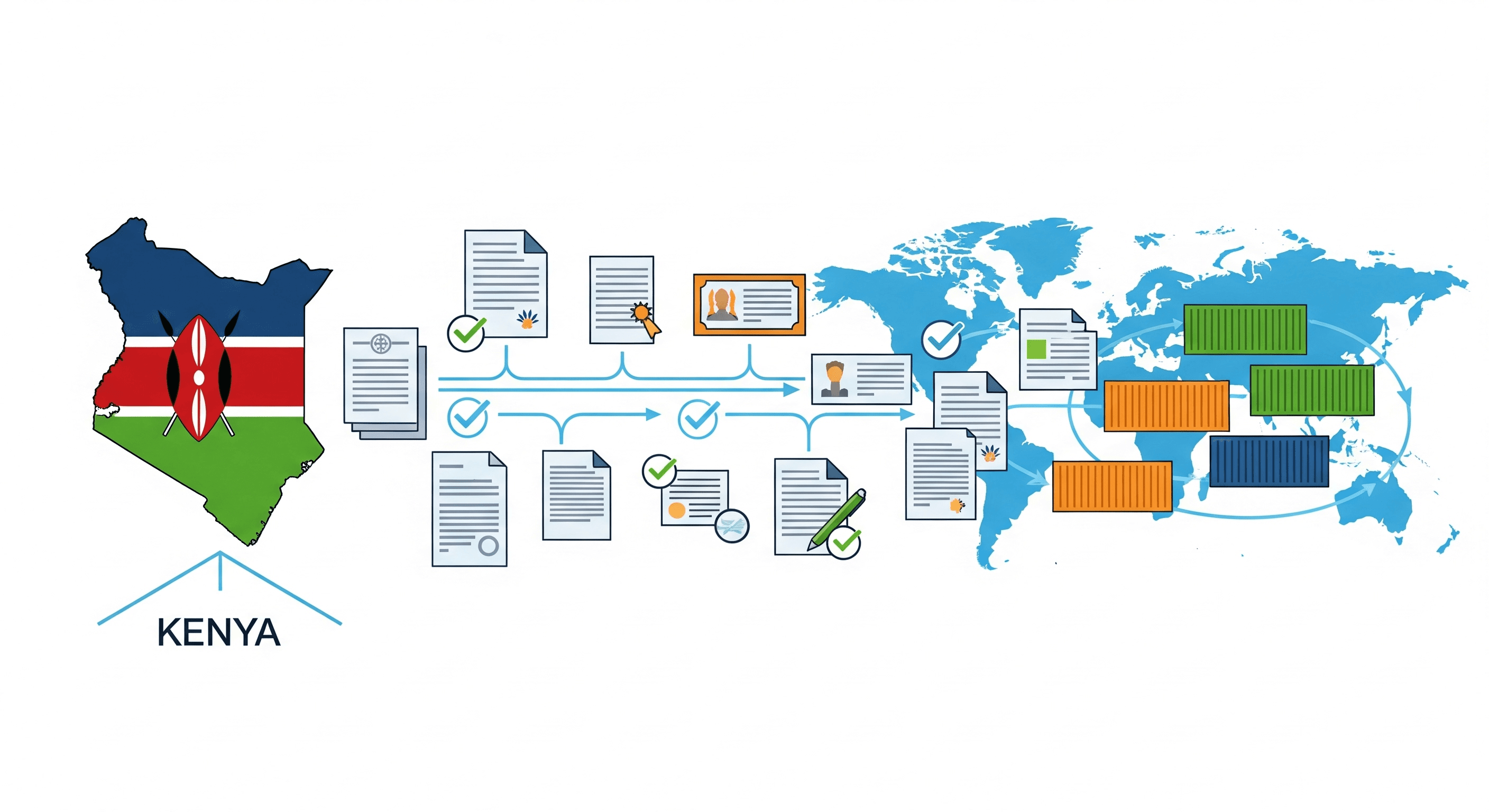
Complete Export Documentation Guide for Kenyan Businesses: From Farm to Foreign Markets
Quick Takeaways for Kenyan Exporters
✅ 5 Critical Documents: Commercial Invoice, Phytosanitary Certificate, Certificate of Origin, Packing List, and Bill of Lading
✅ Processing Time: Allow 10-14 days for complete documentation (rush services available)
✅ Budget Alert: KEPHIS fees increased December 2024 - now KES 0.50/kg + KES 500 per certificate
✅ EU Deadline: TRACES SMS authentication ends June 30, 2025 - upgrade NOW or lose market access
✅ Success Rate: Proper documentation reduces clearance delays by 70%
Did you know? Kenya's export sector just hit a record $11 billion in 2024 - that's 37% higher than previously reported! But here's the catch: 40% of shipment delays still stem from incomplete paperwork.
Meet Sarah, a Nakuru avocado farmer who doubled her EU sales after streamlining her export documentation. "I used to lose entire shipments to paperwork errors," she says. "Now my certificates are processed in 3 days, not 3 weeks."
Whether you're exporting your first container of coffee or scaling up your flower business, this comprehensive guide will transform you from documentation novice to export pro. We've helped over 150 Kenyan businesses navigate export requirements to 15+ countries - and the strategies that work are simpler than you think.
🎯 Understanding Kenya's Export Powerhouse
Kenya's Export Champions (2024 Performance)
Agricultural Exports Lead the Charge (68% of total exports):
- Tea: KES 181.69 billion ($1.35 billion) - World's #3 tea exporter
- Cut Flowers: KES 108 billion ($835 million) - EU's favorite roses
- Coffee: $296.8 million (+12% growth) - Premium Arabica to 40+ countries
- Fresh Produce: KES 80+ billion - Avocados, beans, and herbs
Emerging Sectors:
- Textiles and apparel (AGOA benefits)
- Processed foods and value-added products
- Essential oils and natural extracts
🌍 Your Export Destinations: Where Kenya Sells
-
European Union (21.5% - KES 318 billion)
- Top buyers: Netherlands, Germany, UK, Belgium
- Best for: Flowers, vegetables, coffee, tea
-
Africa (38.9% - KES 576 billion)
- Top buyer: Uganda (KES 167 billion)
- Best for: Manufactured goods, processed foods
-
Asia (30.5% - KES 451 billion)
- Key markets: UAE, Pakistan, India, China
- Best for: Tea, coffee, agricultural products
-
Americas (8% - KES 118 billion)
- Growth markets: USA, Canada
- Best for: Coffee, textiles, handicrafts
Pro Tip: The EU-Kenya Economic Partnership Agreement (effective July 2024) gives you duty-free access to 27 EU countries. That's a massive competitive advantage over other suppliers!
📋 Essential Export Documents: Your Complete Checklist
1. Commercial Invoice (Your Export Foundation)
Why It Matters: This is your business card to international buyers. Get it wrong, and customs will reject your entire shipment.
Required Information Checklist:
✅ Exporter Details:
   - Full company name and address
   - KRA PIN number (P051234567A format)
   - Export license number
   - Contact details (phone, email)

✅ Importer Details:
   - Complete buyer information
   - Destination country
   - Tax identification numbers

✅ Product Information:
   - Detailed product description (not just "coffee" - use "Arabica Coffee Beans, Grade AA, Washed")
   - Correct HS Code (6-digit minimum, 8-digit preferred)
   - Quantity and units
   - Unit price and total value in USD
   - Country of origin: Kenya
   - Incoterms (FOB Mombasa recommended)
Common Mistake Alert: "Never use vague descriptions like 'agricultural products.' Customs needs specifics like 'Fresh Hass Avocados, Class I, 16-20 count per 4kg carton.'"
Sample Invoice Template:
COMMERCIAL INVOICE - ABC Coffee Exporters Ltd
P.O. Box 1234, Nairobi, Kenya | PIN: P051234567A

TO: European Coffee Imports BV
Hoofdstraat 123, Amsterdam, Netherlands

Invoice: CI-2025-001 | Date: 15/01/2025
Terms: FOB Mombasa | Payment: LC at sight

Description: Premium Arabica Coffee Beans, SHB Grade AA
HS Code: 0901.11.90
Origin: Nyeri County, Kenya
Quantity: 100 bags × 60kg = 6,000kg
Unit Price: USD 7.20/kg
Total Value: USD 43,200.00

Certifications: Organic (EU), Fair Trade, UTZ Certified
2. Phytosanitary Certificate (Your Gateway to Global Markets)
Why Critical: Without this KEPHIS-issued document, your fresh mangoes or premium roses will be rejected at EU borders - no exceptions.
New 2025 Fees ⚠️:
- Base fee: KES 0.50 per kilogram (minimum KES 100)
- Certificate fee: KES 500 per phytosanitary certificate
- Express service: 24-hour processing for KES 8,000 (up from KES 5,000)
Processing Timeline:
- Standard: 3-5 working days
- Express: 24 hours (limited slots available)
- Validity: Only 14 days from issue - time your shipments carefully!
Application Essentials:
- Online Application: Use KEPHIS portal (saves 3+ hours vs. physical visits)
- Required Documents:
- Export permit
- Laboratory analysis reports
- Farm inspection certificates
- Packhouse registration documents
Pro Tips for Success:
💡 "Apply Monday-Wednesday for fastest processing. Friday applications often get delayed to the next week." - KEPHIS insider tip
💡 "Keep digital copies of all lab reports. 60% of rejections happen because labs results are missing or expired."
Market-Specific Requirements:
| Destination | Special Requirements | Processing Time |
|---|---|---|
| EU | FCM-free declaration for roses, MRL compliance | 3-5 days |
| UAE | Arabic translation, embassy attestation | 5-7 days |
| China | 18-digit facility registration, cold treatment | 4-6 days |
| USA | APHIS compliance, additional pest declarations | 3-5 days |
3. Certificate of Origin (Unlock Preferential Trade)
Your Trade Agreement Advantage: This document can save your buyers 5-25% in import duties through preferential trade agreements.
Issuing Bodies in Kenya:
- KAM (Kenya Association of Manufacturers): For manufactured goods
- KNCCI (Kenya National Chamber of Commerce): For all products
- Cost: KES 1,500-3,000 per certificate
EPA Certificate Benefits (EU exports):
🎯 Duty-free access to 27 EU countries
🎯 Competitive advantage over non-EPA suppliers
🎯 25-year transition period for gradual liberalization
🎯 Covers 82.6% of EU tariff lines immediately
Application Requirements:
- Commercial invoice
- Export declaration
- Company registration certificate
- KAM/Chamber membership proof
Processing Hack: "Submit applications before 10 AM for same-day processing at KAM. After 2 PM usually means next-day collection."
4. Packing List (Your Shipment's GPS)
Critical Elements:
- Shipping marks and container numbers
- Detailed package breakdown
- Net and gross weights
- Package dimensions (length × width × height)
- Loading sequence information
Sample Format:
PACKING LIST - Shipment ABC-001

Container: MSKU-1234567
Seal No: KE-789456

Package 1-20: Hass Avocados
- 20 cartons × 4kg each = 80kg net
- Gross weight: 85kg including packaging
- Dimensions: 30×20×15cm per carton
- Marks: "KENYA AVOCADOS - LOT 001"
5. Bill of Lading / Air Waybill (Your Cargo Control)
Ocean Freight - Bill of Lading:
- Negotiable: Allows cargo ownership transfer
- Non-negotiable: For direct consignment
- Express B/L: Faster release but limited flexibility
Air Freight - Air Waybill:
- Always non-negotiable
- Faster transit (2-5 days vs 14-35 days ocean)
- Higher costs but perfect for perishables
Cost Comparison (Nairobi to Amsterdam):
- Ocean: $800-1,200 per container (500-600kg flowers)
- Air: $3-5 per kg (typical for flowers, coffee)
🌱 Product-Specific Documentation Deep Dives
Agricultural Products: Your Documentation Roadmap
Fresh Produce (Avocados, Mangoes, French Beans)
Mandatory Documents:
- Phytosanitary Certificate (KEPHIS)
- Export Permit (KEPHIS)
- Laboratory Analysis Report (MRL testing)
- Cold Treatment Certificate (for specific pests)
- Packhouse Registration Certificate
EU Market Requirements 🇪🇺:
MRL Compliance:
  - SGS Kenya testing recommended (only certified MRL lab)
  - Results valid for 6 months
  - Cost: KES 15,000-25,000 per sample

FCM-Free Declaration:
  - Mandatory for roses since April 2025
  - Zero tolerance policy
  - Approved farm list: 134 facilities

Traceability System:
  - Farm-to-fork tracking required
  - Unique batch codes mandatory
  - Digital records retention: 2 years
China Market Update 🇨🇳:
- New Registration System: 18-digit codes replace old 11-digit numbers
- Facility Approval: GACC pre-approval required
- Processing Time: 6-12 months for new registrations
- Annual Renewal: Mandatory facility inspections
Coffee Exports ☕
Quality Requirements:
- Grade Classification: AA, AB, C, T, TT grades
- Moisture Content: Maximum 12.5%
- Defect Count: Less than 86 defects per 300g sample
Certification Stack:
- Coffee Board License (mandatory for all exporters)
- Quality Certificate (NCE quality assessment)
- Organic Certificate (if applicable - Control Union, BCS)
- Fair Trade Certificate (premium market access)
- Warehouse Receipt (for auction purchases)
Market Success Story: "Meru County coffee cooperative increased export prices by 40% after obtaining Fair Trade certification. The premium market access transformed their farmers' livelihoods."
Tea Exports 🫖
Quality Control System:
- KTDA Quality Assurance: ISO 22000 certified
- Mombasa Tea Auction: Transparent price discovery
- Blending Expertise: Meeting specific buyer requirements
Export Procedures:
- Tea Board Registration (exporter license)
- Quality Certificate (pre-shipment inspection)
- Export Permit (Tea Board approval)
- Warehouse Release Order
- Commercial Documents (invoice, packing list)
Success Metrics: Kenya tea reached 96 countries in 2024, with Pakistan buying 42% of total exports worth KSh 70 billion.
Food Processing & Value Addition
KEBS Certificate of Conformity (CoC)
When Required:
- All processed food products
- Products with Kenya Standard (KS) specifications
- Goods valued over $2,000
Assessment Process:
- Product Testing: KEBS-accredited laboratories
- Factory Inspection: Production facility assessment
- Quality Management Review: ISO-based evaluation
- Certificate Issuance: Validity 1-3 years
Cost Structure:
- Application Fee: KES 5,000
- Testing Costs: KES 10,000-50,000 (varies by product)
- Inspection Fee: KES 15,000-30,000
- Certificate Fee: 0.6% of customs value (min. $265, max. $2,700)
🌍 Market-Specific Requirements: Your Regional Playbook
European Union: Premium Market Access
EU Documentation Checklist ✅
Essential Documents:
□ Commercial Invoice (detailed product description)
□ Packing List (weight/dimension accuracy critical)
□ Phytosanitary Certificate (KEPHIS-issued)
□ Certificate of Origin (EPA preferential treatment)
□ Laboratory Analysis Report (MRL compliance)
□ TRACES Health Certificate (via EU importer)
□ Bill of Lading/Air Waybill
□ Insurance Certificate
□ Import License (where required)
EU Regulatory Updates 2025 🚨
TRACES Authentication Deadline:
- SMS authentication ends: June 30, 2025
- Required action: Set up EU Login Mobile App, security key, or passkey
- Impact: Without upgrade, you lose EU market access entirely
False Codling Moth Regulations:
- Zero tolerance: All rose exports since April 2025
- Approved farms: 134 facilities with unique codes
- Compliance system: Rose FCMSA protocol mandatory
Updated MRL Standards:
- Regulation 2024/2612: New limits for clopyralid, difenoconazole, flonicamid
- Testing requirement: Pre-export MRL analysis mandatory
- Approved lab: SGS Kenya (only certified facility)
Middle East Markets: Halal & Cultural Compliance
UAE & GCC Requirements 🕌
Certificate of Origin:
- Embassy legalization: UAE/Saudi Embassy in Nairobi
- Arabic translation: Required for all documents
- Chamber endorsement: KNCCI or KAM certification
Halal Certification Process:
Certifying Bodies:
  - Kenya Bureau of Halal Certification (KBHC)
  - SUPKEM (Supreme Council of Kenya Muslims)
  - SGS Halal Services

Requirements:
  - Halal ingredients verification
  - Production line segregation
  - Muslim supervisor presence
  - Regular facility audits

Validity: 1-3 years
Cost: KES 50,000-200,000 (facility size dependent)
Saudi Arabia SABER Update:
- Product Certificate (PCoC): Required for all commercial goods
- Shipment Certificate (SCoC): Per-consignment verification
- Importer responsibility: Saudi-based companies handle registration
- SASO replacement: Complete system changeover from old COC
Asian Markets: Diverse Requirements
China Export Requirements 🇨🇳
Facility Registration (Critical Update):
- Old system: 11-digit exporter codes (invalid from Sept 2024)
- New system: 18-digit GACC certification numbers
- Timeline: 6-12 months for new approvals
- Renewal: Annual facility inspections required
Documentation Stack:
- GACC Registration Certificate
- Phytosanitary Certificate (KEPHIS)
- Commercial Invoice (Chinese language preferred)
- Certificate of Origin (China-Kenya trade agreement benefits)
- Quality Certificate (product-specific standards)
Market Access Success: "Kenyan avocado exports to China peaked at $40 million before diplomatic issues. Exporters successfully pivoted to EU markets, now capturing 60% of their avocado exports there."
India Market Requirements 🇮🇳
Import Permits:
- Advance authorization: Required for most agricultural products
- Port restrictions: Specific entry points designated
- Quarantine protocols: Enhanced for plant materials
Phytosanitary Additions:
- Pest-specific declarations: Additional statements required
- Treatment certificates: Fumigation/cold treatment proof
- Laboratory endorsement: Indian-recognized facility testing
💻 Digital Revolution: Technology Transforms Trade
KEPHIS Digital Ecosystem
Integrated Systems Available:
-
Export Certification System (ECS):
- Online phytosanitary certificate applications
- Real-time processing status tracking
- Digital certificate delivery to destination countries
- M-Pesa payment integration
-
Plant Import Quarantine Regulatory System (PIQRS):
- Automated risk assessment
- Import permit processing
- Quarantine facility management
User Experience Benefits:
- Time savings: 50% reduction in processing time
- Cost efficiency: 20% lower transaction costs
- Accuracy improvement: 90% reduction in data entry errors
- Transparency: Real-time shipment tracking
Registration Process:
Step 1: Visit kephis.go.ke/online-services
Step 2: Create user account with company details
Step 3: Upload registration documents (CR12, KRA PIN)
Step 4: Pay registration fee via M-Pesa/bank transfer
Step 5: Attend mandatory training session (virtual available)
Step 6: Receive login credentials and start applications
Kenya Trade Net (KenTrade) Revolution
Single Window Benefits:
- Cargo dwell time: Reduced from 7 days to 3 days
- Document processing: 24/7 online availability
- Cost reduction: 30% lower processing fees vs manual systems
- Integration: KRA iTax, KEPHIS, KEBS, KPA systems connected
Service Portfolio:
✅ Import/Export permits
✅ Certificate of Origin (electronic)
✅ Standards compliance certificates
✅ Port clearance integration
✅ Real-time cargo tracking
✅ Payment gateway integration
✅ Document repository (5-year retention)
ROI Calculator: "A typical exporter processing 50 shipments annually saves KES 500,000 in reduced dwell time costs and 200+ hours in documentation time through KenTrade automation."
Blockchain & Future Technologies
Kenya Blockchain Adoption:
- Regulatory framework: Virtual Asset Service Providers (VASP) Bill 2025
- Tax incentives: Digital asset transaction tax reduced from 3% to 1.5%
- Industry events: Kenya Blockchain Conference 2025 (1,500+ participants)
Pilot Programs:
- KTDA Blockchain: Tea traceability from farm to cup
- VeChain Supply Chain: Product authentication and tracking
- TradeLens Integration: End-to-end container visibility
Implementation Benefits:
Immutable Records: Fraud-proof documentation
Real-time Tracking: Supply chain transparency
Reduced Costs: Eliminates intermediary verification
Faster Processing: Automated compliance checking
Enhanced Trust: Buyer confidence in product authenticity
⚠️ Common Mistakes & How to Avoid Them
Documentation Disasters (And How to Prevent Them)
Mistake #1: Vague Product Descriptions
Wrong: "Agricultural products" Right: "Fresh Hass Avocados, Class I, Size 16-20 count, harvested March 2025, Murang'a County origin"
Impact: Customs delays, additional inspections, potential rejections
Mistake #2: Incorrect HS Code Classification
Common Error: Using 6-digit codes when 8-digit required Solution: Use KRA HS Code database or hire certified customs agent Cost of Error: Wrong duty calculations, compliance penalties, shipment delays
Mistake #3: Expired Certificates
High-Risk Documents:
- Phytosanitary certificates (14-day validity)
- Laboratory test results (6-month validity)
- Organic certifications (annual renewal)
Prevention Strategy:
Certificate Tracking System:
  - Excel/Google Sheets with expiry alerts
  - 30-day renewal reminders
  - Emergency express service contacts
  - Document scanning and cloud backup
Mistake #4: Currency & Pricing Inconsistencies
Best Practices:
- Use USD: International standard for commodity exports
- Price matching: Ensure all documents show identical values
- Incoterms clarity: FOB Mombasa most common for Kenya exports
- Payment terms: LC at sight reduces buyer risk
Mistake #5: Missing Market-Specific Requirements
EU Exporters: MRL testing certificates (45% of rejections without this) UAE Exporters: Arabic translations (embassy requirement) China Exporters: 18-digit facility codes (old codes invalid since Sept 2024)
📊 Cost Breakdown: Budget Like a Pro
2025 Fee Structure (Updated January 2025)
KEPHIS Charges 💰
| Service | Previous Rate | New Rate (Dec 2024) | Notes |
|---|---|---|---|
| Fresh Produce | KES 2,000-5,000 | KES 0.50/kg + KES 500 | Minimum KES 100 |
| Container Inspection | Included | KES 500-1,000 | Per container |
| Vessel Inspection | Variable | KES 1,000-10,000 | By vessel size |
| Express Service | KES 5,000 | KES 8,000 | 24-hour processing |
Example Cost Calculation (10,000kg fresh vegetables):
Product fee: 10,000kg × KES 0.50 = KES 5,000
Certificate fee: KES 500
Container inspection: KES 1,000
Total KEPHIS cost: KES 6,500 (vs. KES 3,000 previously)
Complete Export Cost Breakdown
Documentation Costs:
  KEPHIS Certificate: KES 6,500 (10,000kg shipment)
  Certificate of Origin: KES 2,500
  KEBS CoC: 0.6% of value (min $265, max $2,700)
  Laboratory Testing: KES 15,000-25,000
  Embassy Legalization: KES 5,000-8,000

Logistics Costs:
  Clearing Agent: 2-5% of cargo value
  Port Handling: 0.25% of cargo value (wharfage)
  Container Deposit: $2,000-3,000 (refundable)
  Insurance: 0.1-0.3% of shipment value

Government Levies:
  Import Declaration Fee: 3.5% CIF value (min KES 5,000)
  Railway Development Levy: 2% CIF value
  KPA Manifest Fee: $80 per vessel
Cost Optimization Strategies 💡
Volume Discounts:
- Bulk applications: 10+ certificates get 15% discount at KEPHIS
- Annual contracts: Service providers offer 20-30% savings
- Cooperative exports: Share container costs among farmers
Digital Savings:
- Online applications: 10-20% cheaper than manual processing
- Electronic delivery: Eliminates courier costs (KES 2,000-5,000 saved)
- Automated tracking: Reduces follow-up communication costs
Timing Optimization:
- Standard processing: Always cheaper than express
- Off-peak shipping: Avoid month-end port congestion
- Seasonal planning: Book containers during low-demand periods
🤝 Choosing Your Service Providers
Clearing Agent Selection Checklist
Must-Have Credentials:
□ Valid KRA Customs Agent License
□ 5+ years experience in your product category
□ Mombasa Port operational presence
□ Digital platform capabilities (KenTrade integration)
□ Competitive fee structure (2-5% of cargo value)
□ Insurance coverage (minimum KES 10 million)
□ 24/7 emergency contact availability
Questions to Ask Potential Agents:
- "What's your average clearance time for [your product]?"
- "Do you have experience with [destination market] requirements?"
- "Can you provide client references from similar businesses?"
- "What's your success rate for first-time clearance?"
- "How do you handle documentation errors or delays?"
Red Flags to Avoid:
- Promises of "guaranteed 24-hour clearance"
- Unusually low fees (often hide additional charges)
- No physical office presence at port
- Poor communication or delayed responses
- No client references available
Laboratory Services: Quality You Can Trust
KEBS-Accredited Laboratories:
| Laboratory | Specialization | Turnaround | Cost Range |
|---|---|---|---|
| SGS Kenya | MRL testing, food safety | 5-7 days | KES 15,000-25,000 |
| KEBS Labs | Standards compliance | 7-10 days | KES 8,000-15,000 |
| Intertek | Multi-parameter analysis | 5-8 days | KES 12,000-20,000 |
| Bureau Veritas | Organic certification testing | 7-14 days | KES 10,000-18,000 |
Selection Criteria:
- International accreditation: ISO 17025 mandatory
- Market recognition: EU, US regulatory acceptance
- Sample handling: Cold chain maintenance for perishables
- Result format: Compatible with destination requirements
🚀 Building Your Export Documentation System
Internal Capacity Development
Essential Staff Training Areas:
-
Export Documentation Mastery:
- Document preparation and accuracy
- Market-specific requirements
- Digital platform utilization
- Error prevention strategies
-
Regulatory Compliance:
- International trade regulations
- Product-specific standards
- Quality management systems
- Traceability requirements
-
Technology Adoption:
- KEPHIS online portal navigation
- KenTrade system usage
- Digital certificate management
- Data backup and security
Training Providers in Kenya:
- Kenya Institute of Management (KIM): Export management courses
- Export Promotion Council (EPC): Market access training
- Kenya Association of Exporters: Industry-specific programs
- International Trade Centre (ITC): Global best practices
Performance Monitoring System
Key Performance Indicators:
Processing Efficiency:
  Target: <5 days average processing time
  Measure: Application to certificate issuance

Accuracy Rate:
  Target: >99% first-submission approval
  Measure: Rejections due to documentation errors

Compliance Score:
  Target: 100% regulatory compliance
  Measure: Zero clearance delays due to missing documents

Cost Management:
  Target: <3% of export value
  Measure: Total documentation costs per shipment

Customer Satisfaction:
  Target: >95% buyer satisfaction
  Measure: Feedback on documentation quality
Monthly Review Process:
- Document processing times: Track against targets
- Error analysis: Identify common mistakes and solutions
- Cost tracking: Monitor fee increases and optimize spending
- Market feedback: Buyer satisfaction with documentation quality
- Regulatory updates: Stay current with changing requirements
🎯 Success Stories: Learn from the Best
Case Study 1: Nakuru Rose Farm 🌹
Challenge: FCM compliance for EU rose exports after April 2025 regulations
Solution Strategy:
- Implemented integrated pest management (IPM)
- Achieved KEPHIS approval for FCM-free production
- Obtained unique farm traceability code
- Invested in digital monitoring systems
Results:
Compliance Achievement: 100% FCM-free certification
Export Growth: 25% increase in EU sales
Premium Pricing: 15% higher prices vs non-compliant farms
Market Access: Maintained access to premium Dutch auctions
Key Lesson: "Early compliance investment pays off. While competitors lost EU access, we expanded our market share." - Farm Manager, Nakuru Roses Ltd.
Case Study 2: Meru County Coffee Cooperative ☕
Challenge: Low coffee prices and limited market access
Solution Strategy:
- Obtained Fair Trade and Organic certifications
- Implemented full traceability system
- Developed direct buyer relationships
- Enhanced quality control processes
Results:
Price Premium: 40% above conventional coffee prices
Market Expansion: From 3 to 12 destination countries
Farmer Income: Average increase of KES 45 per kg
Quality Score: Consistent 85+ cupping scores
Key Lesson: "Certification costs seemed high initially, but premium prices recovered investment in first season." - Cooperative Manager
Case Study 3: Machakos Avocado Exporter 🥑
Challenge: China market closure required urgent pivot to EU markets
Solution Strategy:
- Rapid EU market entry preparation
- MRL compliance program implementation
- Cold chain optimization for longer shipping
- Direct relationships with European importers
Results:
Market Pivot: 60% of exports now EU-bound vs 80% China previously
Quality Maintenance: <2% rejection rate in EU markets
Revenue Recovery: Achieved 95% of previous China revenue
New Opportunities: Accessing premium organic segment
Key Lesson: "Diversification saved our business. Having EU documentation ready allowed quick market pivot when China closed." - Export Manager
📈 Future-Proofing Your Export Documentation
Regulatory Trends to Watch
EU Market Evolution:
- Digital Product Passport: Coming 2026 for agricultural products
- Deforestation Regulation: EUDR compliance from December 2024
- Carbon Border Adjustment: Potential expansion to agriculture
- Enhanced MRL Standards: Continuous tightening expected
Technology Integration:
- Blockchain adoption: Immutable record keeping
- AI-powered compliance: Automated error detection
- IoT tracking: Real-time shipment monitoring
- Digital twins: Virtual supply chain modeling
Regional Trade Integration:
- AfCFTA implementation: Intra-Africa trade facilitation
- EAC digital standards: Harmonized regional requirements
- COMESA integration: Enhanced certificate recognition
Investment Priorities for 2025-2027
Technology Infrastructure:
Digital Platform Integration:
  - ERP system with export module
  - Document management system
  - Automated compliance checking
  - Real-time tracking capabilities

Staff Development:
  - Export certification training
  - Digital platform proficiency
  - Quality management systems
  - Customer relationship management
Market Diversification:
- Multiple destination compliance: Don't depend on single market
- Product certification stack: Build comprehensive credentials
- Relationship development: Direct buyer connections
- Risk management: Insurance and hedging strategies
🎉 Conclusion: Your Export Success Starts Here
Export documentation isn't just regulatory compliance—it's your competitive advantage in international markets. With Kenya's exports hitting a record $11 billion in 2024 and new trade agreements opening doors, there's never been a better time to get your documentation system right.
Remember the fundamentals:
- Start early: Allow 10-14 days for complete documentation
- Invest in quality: Proper documents reduce delays by 70%
- Stay updated: Regulatory changes happen frequently
- Build relationships: Strong service provider partnerships matter
- Embrace technology: Digital solutions save time and money
The exporters winning in today's market aren't necessarily the biggest—they're the most prepared. With this comprehensive guide, you now have the roadmap to join Kenya's export success story.
🤝 Ready to Transform Your Export Business?
Take Action Today:
Immediate Next Steps (This Week)
- EU TRACES Alert: If you export to EU, set up alternative authentication before June 30, 2025
- Budget Update: Factor in new KEPHIS fees (KES 0.50/kg + KES 500 per certificate)
- China Registration: Update to 18-digit GACC codes if exporting to China
- Document Audit: Review your current certificates for expiry dates
Short-term Goals (Next 30 Days)
- Service Provider Review: Evaluate your clearing agent and lab partners
- Digital Transition: Register for KEPHIS and KenTrade online platforms
- Staff Training: Enroll key team members in export documentation courses
- Market Research: Identify 2-3 new destination markets for diversification
Strategic Investments (3-6 Months)
- Certification Stack: Pursue organic, fair trade, or quality certifications
- Technology Upgrade: Implement export management software
- Relationship Building: Attend trade shows and buyer missions
- Compliance System: Establish internal quality management protocols
📚 Essential Resources & Quick Links
Government Portals (Bookmark These!)
- KEPHIS Online Services: kephis.go.ke - Phytosanitary certificates
- KenTrade Platform: kentrade.go.ke - Single window system
- KEBS Online Portal: kebs.org - Standards compliance
- KRA iTax System: itax.kra.go.ke - Tax compliance
- Export Promotion Council: epc.go.ke - Market intelligence
Industry Associations (Join for Support)
- Kenya Association of Exporters (KAE): Advocacy and training
- Kenya Flower Council (KFC): Horticulture sector support
- Coffee Board of Kenya: Coffee export licensing
- Tea Board of Kenya: Tea quality certification
- Fresh Produce Exporters Association of Kenya (FPEAK): Produce sector
International Standards Bodies
- Fairtrade Africa: fairtrade.net - Fair trade certification
- Control Union Kenya: Organic certification services
- SGS Kenya: Testing and inspection services
- Bureau Veritas: Product certification and testing
💬 Frequently Asked Questions
Documentation Basics
Q: How long does it take to get all export documents ready? A: Allow 10-14 days for first-time exports. Experienced exporters can manage 5-7 days with proper planning. Emergency services are available but cost 2-3x more.
Q: What's the most expensive part of export documentation? A: Laboratory testing (KES 15,000-25,000) and KEBS CoC (0.6% of shipment value) are typically the highest costs. KEPHIS fees are significant for large shipments under the new structure.
Q: Can I handle documentation myself or need an agent? A: Simple exports (coffee, tea) can be self-managed with online platforms. Complex shipments (fresh produce, processed foods) benefit from professional clearing agents, especially for first-time exporters.
Market-Specific Questions
Q: Is the EU market worth the extra documentation requirements? A: Absolutely. EU buyers pay 15-25% premium for properly documented, certified products. The EPA agreement gives you duty-free access, making it highly profitable despite compliance costs.
Q: How do I know if my product needs halal certification? A: Required for Muslim-majority markets (UAE, Saudi Arabia, Malaysia, Indonesia). Even if not mandatory, halal certification opens additional market segments and can increase your buyer base by 30-40%.
Q: What happens if my documents are rejected at destination? A: Immediate action required. Contact your clearing agent and KEPHIS/KEBS for emergency re-certification. Costs range KES 50,000-200,000 for express re-processing, plus potential cargo storage fees.
Technology & Digital Solutions
Q: Are the online platforms reliable? A: KEPHIS and KenTrade platforms are stable with 99%+ uptime. System maintenance happens weekends, so avoid Friday applications. Mobile apps work well for tracking but use desktop for applications.
Q: How secure are digital certificates? A: Highly secure with blockchain verification and QR code authentication. Digital certificates are actually more fraud-resistant than paper documents and accepted by all major destinations.
🎯 Final Expert Tips
Insider Secrets from 15+ Years of Export Experience
Timing Hacks:
- Monday applications: Fastest processing at government agencies
- Avoid month-end: Port congestion increases costs and delays
- Plan around holidays: Government offices close for multiple days
Relationship Building:
- Know your KEPHIS inspector: Personal relationships speed up processes
- Regular communication: Monthly check-ins with key service providers
- Industry events: Best networking happens at trade fairs and conferences
Cost Optimization:
- Bulk planning: Process multiple shipments together for discounts
- Off-season prep: Renew certificates during slow periods for faster service
- Group logistics: Share containers with compatible exporters
Quality Assurance:
- Double-check everything: 90% of delays come from simple errors
- Photo documentation: Keep pictures of all documents for quick reference
- Backup plans: Always have Plan B for critical shipments
Words from Successful Exporters
"The best investment we made was hiring a dedicated export documentation officer. The ROI was 500% in the first year just from reduced delays and errors." - Managing Director, Kiambu Coffee Estates
"Don't try to cut corners on documentation costs. One rejected shipment costs more than a year of proper certification." - Export Manager, Eldoret Grain Processors
"Start with one market and perfect your processes before expanding. Master the EU requirements, then other markets become much easier." - Founder, Nakuru Fresh Exports
📞 Get Expert Help When You Need It
Still feeling overwhelmed? That's completely normal - export documentation can seem daunting at first. Remember, every successful exporter started exactly where you are now.
Professional Support Options
📧 Documentation Review Service
- Expert analysis of your current documents
- Identification of compliance gaps
- Customized improvement recommendations
- 48-hour turnaround time
🎓 Export Readiness Assessment
- Company capability evaluation
- Market entry feasibility study
- Documentation system audit
- 3-month action plan
🚀 Market Entry Support
- End-to-end launch assistance
- Document preparation and submission
- Buyer introduction services
- First-shipment success guarantee
📱 Emergency Documentation Support
- 24/7 urgent problem resolution
- Express re-certification services
- Crisis management consultation
- Same-day document correction
🌟 Your Export Journey Starts Now
Kenya's position as East Africa's export hub isn't accidental - it's built on the foundation of businesses like yours that take documentation seriously, invest in quality systems, and never stop improving.
With $11 billion in exports and growing, there's plenty of opportunity for prepared exporters. The difference between businesses that thrive and those that struggle often comes down to one thing: systematic approach to export documentation.
You now have the complete roadmap. The question isn't whether you can succeed in international markets - it's how quickly you'll implement these strategies to capture your share of Kenya's export success.
The world is waiting for your products. Are your documents ready?
This guide is updated regularly with the latest regulatory changes and best practices. Last updated: January 2025. For the most current information, always verify requirements with official government sources.
Related Guides (Coming Soon)
- Mastering Cold Chain Logistics for Fresh Produce Exports
- Building Profitable Relationships with International Buyers
- Export Finance Options: From Letters of Credit to Trade Insurance
- Kenya's Hidden Export Gems: Emerging Products with Global Potential
About the Author
This guide was developed by export specialists with over 150 successful market entry projects across 15+ countries. Our team combines practical experience with regulatory expertise to deliver actionable guidance for Kenyan exporters.
Connect with us: LinkedIn | WhatsApp Business | Email

Jasmine Njeri
•Content TeamExpert insights from Ervin Solutions