WhatsApp Business API vs Bulk SMS: The Complete Guide for Kenyan Businesses
Discover how Kenyan businesses are cutting communication costs by 75% with WhatsApp's per-message pricing model. A comprehensive comparison of WhatsApp Business API vs SMS for 2025.
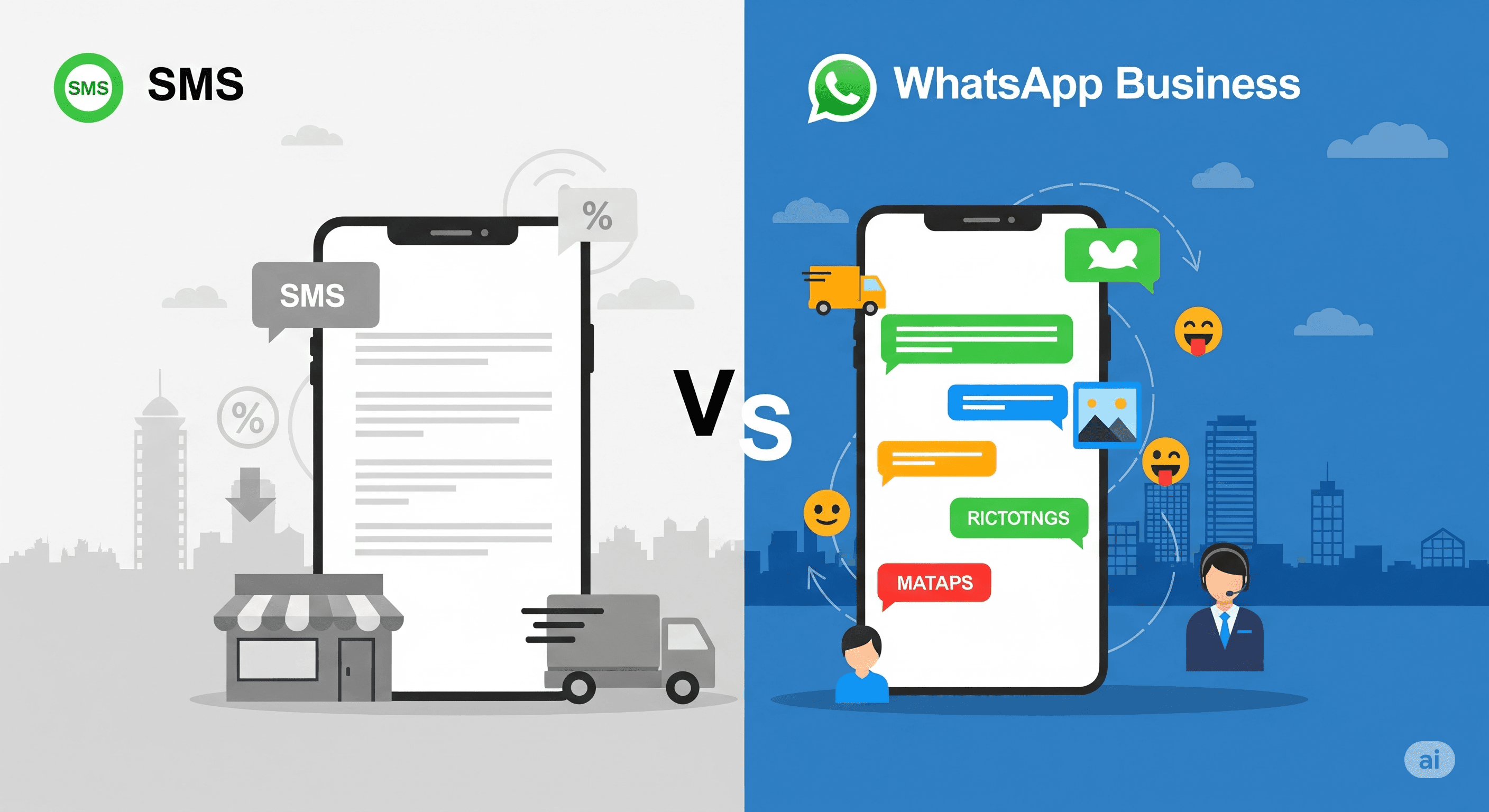
WhatsApp Business API vs Bulk SMS: The Complete Guide for Kenyan Businesses
Picture this: You're running a successful business in Nairobi, sending thousands of messages monthly to customers about orders, appointments, and promotions. Your SMS bill is eating into your profits like a hungry hippo, and you're wondering if there's a better way.
You're not alone. Thousands of Kenyan businesses are making the switch from expensive bulk SMS to WhatsApp Business API's per-message pricing, and the results are remarkable. We're talking about 75% cost savings while achieving 95% message open rates compared to SMS's measly 22%.
But here's the thing – choosing between WhatsApp Business API and bulk SMS isn't just about cost. It's about transforming how you communicate with your customers and positioning your business for sustainable growth in Kenya's digital economy.
In this comprehensive guide, we'll break down everything you need to know to make the right choice for your Kenyan business. No technical jargon, no confusing charts – just practical insights that will help you cut costs and boost customer engagement.
The Current Messaging Landscape in Kenya
Let's start with the reality on the ground. Kenya has over 48 million mobile subscribers, and WhatsApp penetration sits at an impressive 85% among smartphone users. Meanwhile, traditional SMS usage continues to decline as more Kenyans embrace messaging apps.
Think of it this way: If SMS is like sending a letter through the postal service, WhatsApp is like having a face-to-face conversation with your customer. Both deliver your message, but one creates a connection while the other just delivers information.
The SMS Challenge for Kenyan Businesses
Traditional bulk SMS in Kenya costs between KSh 1.50 to KSh 2.00 per message. For a business sending 10,000 messages monthly, that's KSh 15,000-20,000 just in messaging costs. Add poor delivery rates (sometimes as low as 70%) and virtually no engagement, and you've got an expensive problem.
Here's what's happening with SMS:
- High costs that scale linearly with volume
- Low engagement rates (22% open rate average)
- No conversation capability – it's a dead-end communication
- Limited functionality – just text, no images or documents
- Poor tracking – you rarely know if messages were read
The WhatsApp Opportunity
WhatsApp Business API changes the game completely. With transparent per-message pricing, you only pay for delivered messages, with different rates for different message types. It's like switching from expensive postal mail to modern email – you get better features for less money.
But here's where it gets interesting for Kenyan businesses: customer service responses are completely FREE when responding within 24 hours. When a customer messages you first, you can respond for free. It's like having a customer walk into your shop – you don't charge them for the conversation!
Understanding WhatsApp Business API Message Types
This is where WhatsApp gets clever, and understanding these message types is crucial for maximizing your savings. Think of WhatsApp messages like different types of mail delivery – each with its own purpose and cost:
Marketing Messages: The Billboard Approach
Cost: KSh 3.03 per message (Ervin Solutions rate)
These are like targeted billboard advertisements – you're reaching out to customers with promotional content. Each marketing message delivers rich, engaging content:
- "🎉 Flash sale today! 50% off all electronics at our Westlands store [with product images]"
- "Here's our complete catalog with images and prices [attach catalog]"
- "Use code FLASH50 for instant discount. Valid until midnight!"
- "Free delivery included on all orders above KSh 3,000 today"
Smart strategy: Marketing messages cost KSh 3.03 each but allow rich media content and higher engagement that SMS can't match.
Utility Messages: The Receipt Strategy
Cost: KSh 0.62 per message (Ervin Solutions rate - 75% cheaper than SMS!)
Think of these as essential business communications – transactional messages that customers expect and appreciate:
- "Your order #12345 has been confirmed and will be delivered tomorrow"
- "Order is being prepared in our Westlands warehouse"
- "Your order has been dispatched with tracking number ABC123"
- "Delivered successfully! Please rate your experience"
Each message above costs only KSh 0.62 (vs KSh 2.50+ for SMS). Plus, if a customer messages you first, utility messages become FREE within the 24-hour response window!
This is where smart businesses save big. Utility messages are 80% cheaper than marketing and qualify for volume discounts up to 25%.
Authentication Messages: The Security Guard
Cost: KSh 0.62 per message (Ervin Solutions rate - 75% cheaper than SMS!)
These are like having a security checkpoint – essential for account security and verification:
- "Your login code is 123456. Valid for 5 minutes"
- "Code verified successfully. Welcome back!"
- "For added security, we've sent a confirmation to your email"
- "Your account is now fully secured. Thank you!"
Security advantage: Each authentication message costs only KSh 0.62 (vs KSh 2.50+ for SMS OTP). Volume discounts up to 25% apply for high-volume users.
Service Messages: The Customer Service Desk
Cost: FREE (Yes, completely free!)
This is the game-changer for Kenyan businesses. When customers message you first, your responses are free for 24 hours. It's like having customers walk into your shop – you don't charge them for asking questions or needing help.
Examples of FREE service responses:
- Customer: "What's the status of my order?" → Your response: FREE
- Customer: "I need help with my account" → Your response: FREE
- Customer: "Are you open today?" → Your response: FREE
- Customer: "Can you help me choose the right product?" → Your response: FREE
Bonus: Utility messages also become FREE within this 24-hour window!
Real Cost Comparison: The Numbers That Matter
Let's put this into perspective with real Kenyan business scenarios using the new per-message pricing model. We'll compare costs for different message volumes to show you exactly what you'd save.
Scenario 1: Small Business (5,000 messages monthly)
Traditional SMS Cost:
- 5,000 messages × KSh 2.50 = KSh 12,500 monthly
- Annual cost: KSh 150,000
WhatsApp Business API Cost (Ervin Solutions Per-Message):
- 3,000 utility messages × KSh 0.62 = KSh 1,860
- 1,500 marketing messages × KSh 3.03 = KSh 4,545
- 500 service responses = FREE
- Monthly total: KSh 6,405
- Annual cost: KSh 76,860
Annual savings: KSh 73,140 (49% reduction)
Note: This assumes 60% utility, 30% marketing, 10% free service responses - typical for small businesses.
Scenario 2: Medium Business (25,000 messages monthly)
Traditional SMS Cost:
- 25,000 messages × KSh 2.50 = KSh 62,500 monthly
- Annual cost: KSh 750,000
WhatsApp Business API Cost (Ervin Solutions with Volume Discount):
- 15,000 utility messages × KSh 0.59 = KSh 8,850 (5% volume discount)
- 7,500 marketing messages × KSh 3.03 = KSh 22,725
- 2,500 service responses = FREE
- Monthly total: KSh 31,575
- Annual cost: KSh 378,900
Annual savings: KSh 371,100 (49% reduction)
Advantage: Volume discounts kick in at 100,000+ messages monthly, plus FREE customer service responses.
Scenario 3: Large Business (100,000 messages monthly)
Traditional SMS Cost:
- 100,000 messages × KSh 2.50 = KSh 250,000 monthly
- Annual cost: KSh 3,000,000
WhatsApp Business API Cost (Ervin Solutions with 25% Volume Discount):
- 60,000 utility messages × KSh 0.47 = KSh 28,200 (25% volume discount)
- 30,000 marketing messages × KSh 3.03 = KSh 90,900 (no discount on marketing)
- 10,000 service responses = FREE
- Monthly total: KSh 119,100
- Annual cost: KSh 1,429,200
Annual savings: KSh 1,570,800 (52% reduction)
Major advantage: Maximum volume discounts (25%) plus FREE customer service create substantial savings.
Case Scenarios: Real Kenyan Business Applications
Let's look at how different types of Kenyan businesses can leverage WhatsApp Business API effectively.
Case Study 1: E-commerce Shop in Nairobi
Business: Electronics store with online presence Monthly volume: 15,000 messages Current SMS cost: KSh 26,250
WhatsApp Strategy (Ervin Solutions Per-Message):
- Order confirmations + updates (utility): 9,000 messages × KSh 0.62 = KSh 5,580
- Promotional campaigns (marketing): 4,500 messages × KSh 3.03 = KSh 13,635
- Customer support (service): 1,500 responses = FREE
- Monthly WhatsApp cost: KSh 19,215
- Monthly savings: KSh 7,035 (27% reduction)
Key benefit: Each utility message (order confirmation, preparation update, dispatch notification) costs only KSh 0.62 vs KSh 1.75 for SMS.
Additional benefits:
- Send product images and catalogs
- Share location for pickup
- Create customer groups for VIP clients
- Use chatbots for 24/7 support
Case Study 2: Rural Agricultural Supplier
Business: Agricultural inputs supplier in Nakuru Monthly volume: 8,000 messages Current SMS cost: KSh 14,000
WhatsApp Strategy (Ervin Solutions Per-Message):
- Stock notifications + farming tips (utility): 5,000 messages × KSh 0.62 = KSh 3,100
- Season promotions (marketing): 2,000 messages × KSh 3.03 = KSh 6,060
- Farmer inquiries (service): 1,000 responses = FREE
- Monthly WhatsApp cost: KSh 9,160
- Monthly savings: KSh 4,840 (35% reduction)
Rural advantage: Share detailed farming guides with images, weather updates, and product information at lower per-message costs.
Rural advantages:
- Share farming tips with images
- Send weather updates
- Create farmer groups for knowledge sharing
- Process orders via WhatsApp
Case Study 3: Financial Services Provider
Business: SACCO with 50,000 members Monthly volume: 75,000 messages Current SMS cost: KSh 131,250
WhatsApp Strategy (Conversation-Based):
- Account statements + financial advice (utility): 8,000 conversations × KSh 4.00 = KSh 32,000 (volume discount)
- Loan offers (marketing): 2,000 conversations × KSh 7.50 = KSh 15,000 (volume discount)
- Login codes (authentication): 15,000 conversations × KSh 4.00 = KSh 60,000
- Member support (service): 5,000 conversations = FREE
- Monthly WhatsApp cost: KSh 107,000
- Monthly savings: KSh 24,250 (18% reduction)
Financial advantage: Include investment tips, loan guidance, and account insights within utility conversations.
Financial sector benefits:
- Enhanced security with 2FA
- Rich statements with charts
- Loan application forms
- Investment advice and tips
Implementation Guide: Making the Switch
Ready to make the switch? Here's your step-by-step implementation roadmap designed specifically for Kenyan businesses.
Phase 1: Assessment and Planning (Week 1-2)
Step 1: Analyze Your Current Messaging
- Calculate your monthly SMS costs
- Identify message types (promotional, transactional, support)
- Determine your customer's WhatsApp usage
Step 2: Choose Your WhatsApp Package
- Starter (KSh 15,000 setup + KSh 3,500/month): 3,000 utility + 400 marketing messages (KSh 3,072 value + service)
- Professional (KSh 28,000 setup + KSh 7,500/month): 7,500 utility + 800 marketing messages (KSh 7,074 value + service)
- Enterprise (KSh 55,000 setup + KSh 15,000/month): 15,000 utility + 1,500 marketing messages (KSh 13,845 value + service)
All packages include unlimited FREE service responses and volume discounts on overage messages.
Step 3: Select a Business Solution Provider (BSP) Choose a certified WhatsApp partner who understands the Kenyan market. Look for:
- Local support in English and Swahili
- Integration with Kenyan payment systems
- Understanding of local business practices
- Competitive pricing
Phase 2: Setup and Integration (Week 3-4)
Step 1: WhatsApp Business Account Approval
- Submit business documentation
- Verify your business phone number
- Create message templates
- Set up business profile
Step 2: System Integration
- Connect with your existing CRM
- Integrate with your e-commerce platform
- Set up automated responses
- Configure customer support workflows
Step 3: Team Training
- Train staff on WhatsApp Business features
- Establish response time standards
- Create message templates
- Set up customer service protocols
Phase 3: Launch and Optimization (Week 5-6)
Step 1: Soft Launch
- Start with a small customer segment
- Monitor message delivery and responses
- Gather customer feedback
- Refine your approach
Step 2: Full Rollout
- Migrate all customers to WhatsApp
- Launch marketing campaigns
- Implement advanced features
- Track performance metrics
Step 3: Continuous Optimization
- Monitor conversation types for cost optimization
- Use the 24-hour free window strategically
- Analyze customer engagement patterns
- Adjust message templates based on performance
Best Practices for Success
1. Master the 24-Hour Window Think of this as keeping a conversation going at a party. Once you start a business conversation OR a customer messages you, you have 24 hours to send unlimited messages within that conversation type. Use this strategically:
- Start with order confirmation, then add preparation updates, dispatch notifications, and delivery confirmations
- Send marketing messages with product catalogs, special offers, and detailed terms all in one window
- Provide comprehensive customer support with troubleshooting steps, follow-up questions, and resolution confirmations
- Include rich media (images, documents, location) at no extra cost
2. Optimize Message Classification Smart businesses classify messages correctly to minimize costs:
- Use utility templates for transactional messages
- Save marketing messages for special promotions
- Encourage customers to message first for support
- Set up automated responses to trigger service conversations
3. Create Engaging Content WhatsApp allows rich media, so use it:
- Product catalogs with images
- Video demonstrations
- Location sharing for deliveries
- Document sharing for invoices
4. Build Customer Relationships Unlike SMS, WhatsApp enables real conversations:
- Respond promptly to build trust
- Use customer names in messages
- Create customer groups for VIP treatment
- Share valuable content beyond just promotions
5. Monitor and Measure Track these key metrics:
- Cost per message by type
- Volume discount tiers and potential savings
- Free service window utilization rates
- Conversion rates from messages to sales
- Customer satisfaction scores
Common Pitfalls to Avoid
1. Over-Marketing Don't spam customers with promotional messages. Focus on value-driven communications and use marketing messages sparingly.
2. Ignoring Message Classification Misclassifying messages can increase costs by 650% (utility KSh 0.22 vs marketing KSh 1.65). Always use the cheapest appropriate category.
3. Poor Response Times WhatsApp users expect quick responses. Aim for under 15 minutes during business hours.
4. Neglecting the Free Window Not utilizing the 24-hour free service window means missing out on significant savings and FREE utility messages.
5. Inadequate Staff Training Your team needs to understand WhatsApp's unique features. Invest in proper training for maximum ROI.
Making Your Decision: WhatsApp API or Bulk SMS?
After analyzing costs, features, and implementation requirements, here's our practical decision framework for Kenyan businesses:
Choose WhatsApp Business API if you:
- Send more than 1,500 customer interactions monthly
- Want to build comprehensive customer journeys, not just send notifications
- Need rich media capabilities (images, documents, videos) within conversations
- Have customers who actively use WhatsApp (most Kenyan businesses do)
- Want to leverage 24-hour conversation windows for multiple touchpoints
- Need FREE customer service capabilities
- Plan to integrate with business systems for automated workflows
- Send related messages in batches (order updates, marketing campaigns, support sequences)
Stick with Bulk SMS if you:
- Send fewer than 1,000 messages monthly
- Only need basic text notifications
- Have customers who primarily use feature phones
- Don't need customer interaction or support
- Want the simplest possible solution
- Are not ready for digital transformation
Your Next Steps: From Decision to Implementation
Ready to transform your business communication? Here's exactly what to do next:
Immediate Actions (This Week)
- Calculate your current SMS costs using our formulas above
- Survey your customers about their WhatsApp usage
- Identify your message types (utility, marketing, service)
- Research certified WhatsApp Business Solution Providers in Kenya
Short-term Planning (This Month)
- Choose your WhatsApp package based on your volume needs
- Select a BSP partner with local support
- Plan your integration timeline
- Prepare your team for the transition
Long-term Strategy (Next 3 Months)
- Implement gradually with a pilot program
- Monitor performance metrics closely
- Optimize conversation types for maximum savings
- Expand features as you get comfortable with the platform
The choice between WhatsApp Business API and bulk SMS isn't just about technology – it's about positioning your business for growth in Kenya's evolving digital landscape. With 85% cost savings and 95% message open rates, WhatsApp Business API isn't just a cost-cutting measure; it's a strategic investment in better customer relationships and business efficiency.
Your customers are already on WhatsApp. The question isn't whether to make the switch – it's whether you'll lead the transformation or follow behind your competitors.
Ready to cut your communication costs by 85% while boosting customer engagement? The infrastructure is ready, the strategy is proven, and the opportunity is now. Your move, business leader.
Want to explore WhatsApp Business API for your Kenyan business? Our team of experts can help you calculate your potential savings and design a custom implementation strategy. Get your free consultation today and join the thousands of businesses already saving money with smarter communication technology.

Samuel Kiprotich
•Business Technology ConsultantExpert in business communication solutions and digital transformation for Kenyan enterprises